 Keen
Get Keen
Memory exercises for adults: a 5-minute routine you can print
Try five everyday memory exercises: chunk a number, turn a list into a story, link a name to a face, make a when-then plan and retell a short paragraph. Download the free large-print worksheet for answer spaces and a seven-day tracker.
Most memory exercise sheets are puzzles: word searches, spot the difference. These five are different. Each one copies something you need in real life, a phone number, a shopping list, a new name, and teaches the method that makes it stick. One minute each. A pen, paper and a timer are all you need.
Download large-print PDF worksheet (4 pages)
Which five memory exercises can you try?
1. Hold a number in pieces 1 minute
Pick a phone number you do not know by heart, from a bill or a leaflet. Break it into pieces of two or three digits: 07700 900 461 becomes "077, 00, 900, 461" or whatever split feels natural. Say the pieces out loud twice, look away and write the number down. Check it. This is chunking: a long number becomes a few short ones.
2. Carry a list as a story 1 minute
Write these six things: eggs, soap, bread, lemons, batteries, coffee. Now join them in one odd little story: an egg slips on a bar of soap, lands on a loaf of bread, which a lemon uses as a bed, while a battery makes coffee. Turn the paper over. Do not write the list again yet. You will recall it at the end.
3. Catch a name and a face 1 minute
Open a newspaper, a magazine or a news site and find a photo of someone you do not know. Read their name. Say it back once ("Morag Ellis"), notice one feature of the face (the round glasses), and make a picture that joins them: Morag's glasses are full of morning tea. If you have time, do the same with a second face. The full method is in our guide on how to remember names.
4. Plan to remember later 1 minute
Choose one small thing to do today: take the bins out, call your sister, water the plant. Say it as a when-then plan: "When I put the kettle on after lunch, then I call my sister." Picture the kettle and the phone together. Tonight, check whether it worked.
5. Read and retell 1 minute
Read one short news item, three or four sentences. Cover it and answer four questions out loud: who, what, where, why. Then uncover it and check. These four questions give you something to hold on to.
Finish: the list again
Without looking, write down the six things from exercise 2. Then try the name (or names) from exercise 3. Write how many list items you recalled on the tick sheet. Missing some is normal; the aim is practice, not a perfect score.
What is on the printable memory worksheet?
The PDF worksheet is four pages in large print, with no puzzles to solve and nothing to buy:
- Page 1: the number and the shopping-list story, with lines to write on.
- Page 2: a name and face from the newspaper, and a when-then plan for today.
- Page 3: read and retell, then recall the list and the name without looking back. Fold pages 1 and 2 under first.
- Page 4: a seven-day tracker with big boxes to tick and a row for your list score.
Most of the text is 14 point, with bigger headings and wide lines to write on. It is A4; on US Letter paper choose "Fit to page" when you print. You are welcome to copy it for a parent, a memory group or a class, Please keep the footer with the web address.
How can you make memory practice a habit?
- Same time, same place. Tie it to something you already do every day, such as the first cup of tea.
- Change the material. New numbers, new lists, new faces each day. Repeating the same list soon becomes too easy.
- Use it the same day. Carry the real shopping list in your head and the real number, not only the practice one.
- Keep the sheet in sight. A tick on the fridge is a small reward, and a gap tells you which day slipped.
How can you track seven days of practice?
Tick each exercise you did. In the last row, write how many of the six list items you recalled.
| Exercise | Mon | Tue | Wed | Thu | Fri | Sat | Sun |
|---|---|---|---|---|---|---|---|
| 1. Number in pieces | |||||||
| 2. Story list | |||||||
| 3. Name and face | |||||||
| 4. When-then plan | |||||||
| 5. Read and retell | |||||||
| Words recalled at the end (of 6) |
From keen.oyrial.com/memory-exercises. Free to print and share.
Want to see where you start?
Before your first week, try the free memory test in your browser: a word list, a number test and a delayed recall, about three minutes, no sign-up. You can take it again after a week, to see how it feels.
Questions
What are good memory exercises for adults?
Exercises that copy real life: holding a phone number in your head, carrying a shopping list without paper, catching a new name, remembering to do something later, and recalling what you just read.
How long should I practise each day?
Five minutes is enough to start. A short routine you keep doing beats a long one you skip. Do it at the same time each day, for example with your morning tea.
Is there a printable version?
Yes. Download the free four-page, large-print PDF worksheet with the five exercises, answer spaces and a seven-day tracker. You can also print this web page.
Do I need anything for these exercises?
A pen, a piece of paper and a clock or phone timer. Nothing to buy and no sign-up.
Can memory exercises prevent dementia?
No exercise can promise that. These are practice for everyday memory, not a treatment. If memory problems affect your daily life, the NHS advises seeing a GP (NHS: memory loss).
What is the best exercise to improve memory?
There is no single best one. The exercises that help most in daily life copy real tasks: hold a phone number in two or three chunks, link a shopping list into a short story, and say a new name back with one picture. Practise for five minutes a day at home and use each one the same day.
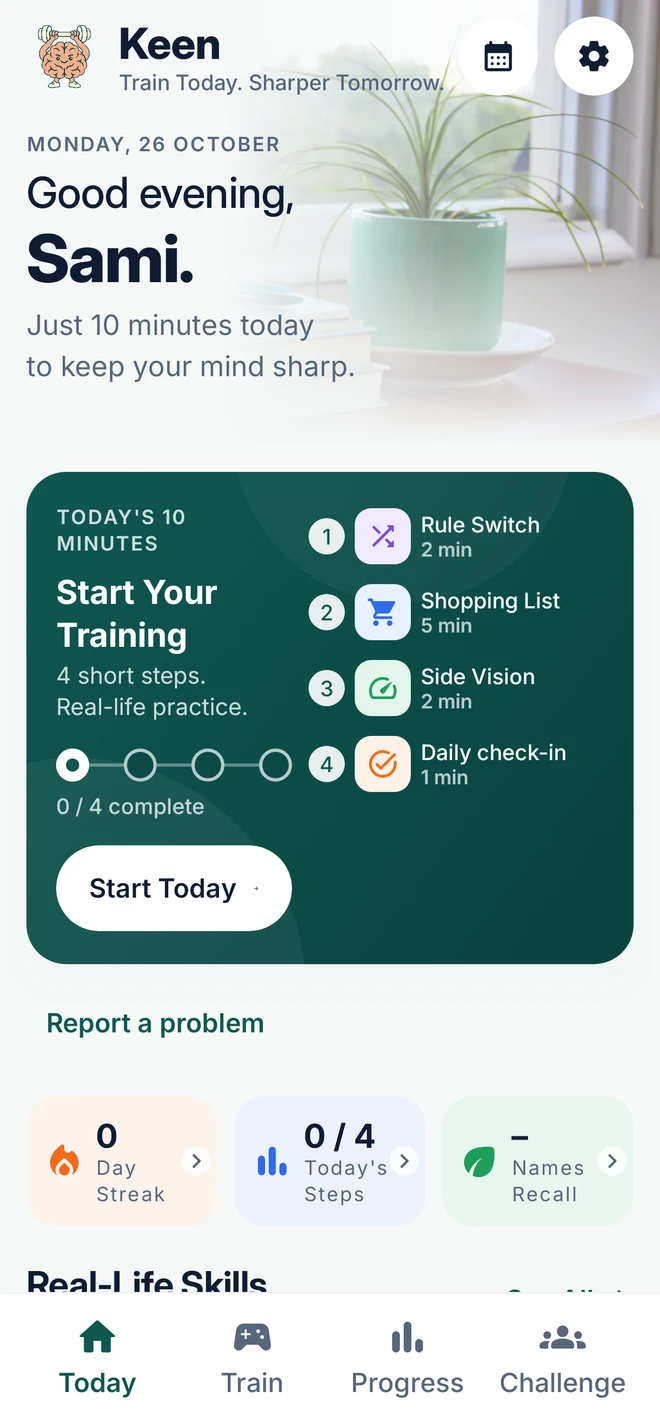
Ten calm minutes a day, in an app
Keen turns these same methods into short lessons for adults 40 and over: names and faces, shopping lists, PINs, what you read, when-then plans, where you put things and everyday maths. It asks again the next day, so you can see what stuck. Keen is on Google Play for Android.