 Keen
Get Keen
Free online memory test for adults
This free memory test lets you try list recall and number recall, then practise a simple technique on another list. It is a practice activity, not a diagnosis or a comparison with other people.
Three short parts: read a shopping list, repeat a few numbers, then type the list from memory. At the end you can try one simple technique on a second list for yourself. Nothing is saved or sent anywhere.
Ready when you are
Start the test
Find a quiet minute. No pen and paper: the point is to keep things in your head. It takes about three minutes, plus two more for the bonus list.
What does your result mean?
Words. In the US Health and Retirement Study, people hear 10 everyday words and say back as many as they can straight away. A 2015 study comparing that with an online version found average scores of about 6 words in the interview group (median age 60) and about 7 online (women aged 40 to 69). When asked again a few minutes later, both groups averaged about 5 (Runge and others, 2015). This test is a little different: you read the list for longer, but you type it in later, after the numbers, so the later average of about 5 is the closer one. Use these averages as a rough guide only.
Numbers. Repeating digits in order is called digit span. In a study of adults aged 18 to 65, the average longest span was about 6 digits (Woods and others, 2011). Most people scored within about one digit of that.
Any score. One go at a short test says very little. Tiredness, worry, a noisy room or a small phone screen can all cost a few words. If you want a fairer picture, try it again on another day, at a calm moment.
This test is for interest and practice. It is not a medical test and cannot tell you whether anything is wrong. The NHS says some memory loss can be a natural part of getting older, and advises seeing a GP if you keep having problems with your memory (NHS: memory loss). If you or someone close to you is worried, talk to a doctor; that is always a good reason to go.
How does the test work?
- Part 1, the shopping list: ten everyday things on screen for 40 seconds. You only read them.
- Part 2, numbers: digits appear one per second. Type them back in the same order. It starts with 3 digits and adds one each time you get it right, until you miss twice at the same length.
- Part 3, recall: type every item from the list you still remember. The numbers in between make it a test of holding on, not just of the last few seconds.
- Bonus, the story method: a second list, but this time you link the items into one silly story. Many people remember more this way. It is the same idea as in our guide on how to remember names: give new information a picture to hang on.
Why does a story help you recall a list?
A list of separate words is hard to hold because nothing joins them. A story turns ten loose things into one chain: each picture leads to the next, so remembering the first item pulls out the rest. The odder the pictures, the better they stick. It takes a little practice, so if your bonus score was not higher, try it on your next real shopping list.
Questions
How long does the memory test take?
About three minutes. You remember a 10-item shopping list, repeat strings of numbers that get longer, type back the list, and can try a bonus second list using a story to see if it helps.
What does the memory test check?
Everyday memory: how many shopping items you can recall, and how many digits you can hold in your head. It does not test names or faces.
Is this a medical or dementia test?
No. It is a practice check for everyday memory, not a medical test, and it cannot diagnose anything. If memory problems affect your daily life, the NHS advises seeing a GP.
Do I need to sign up?
No. The test runs in your browser with no sign-up.
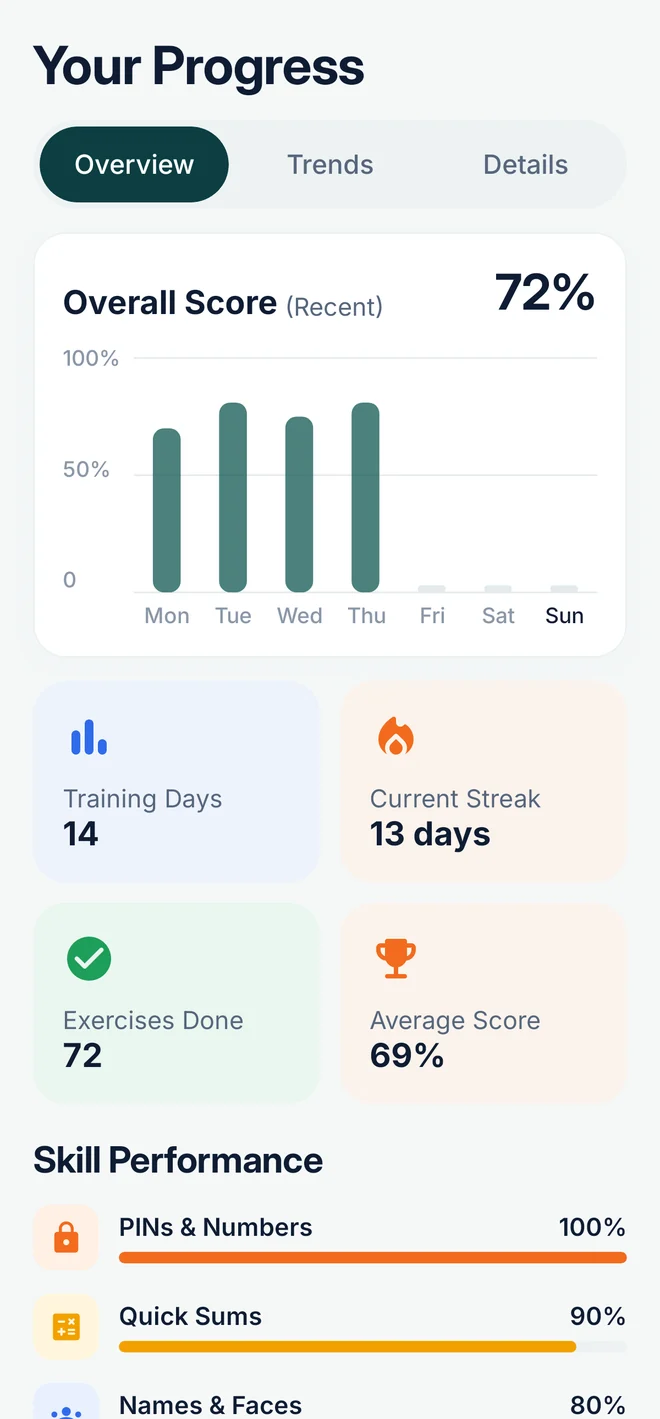
Practise it ten minutes a day
Keen is an Android app for everyday memory, made for adults 40 and over. Its shopping list lesson teaches the story method you just tried, and other lessons cover names and faces, PINs and phone numbers, and where you put your keys. A monthly check-up uses material you have never practised, so you can see whether the skills carry over.