 Keen
Get Keen
Corsi block test: how many blocks can you tap back?
Nine blocks sit on a board. Some of them light up one at a time. Tap them back in the same order. The pattern gets one block longer each time you are right, and your score is the longest pattern you got right.
Loading the test…
English Deutsch
How does the Corsi block test work?
- Watch: blocks light up one at a time, one per second. The first pattern is 2 blocks.
- Tap: when the lights stop, tap the same blocks in the same order. In backward mode, tap them last block first.
- Two tries: you get two patterns at each length. Get one right and the next pattern is one block longer. Miss both and the test ends.
- Score: your block span is the longest pattern you tapped back right. The most you can get is 9.
Every pattern is new, and no block is used twice in one pattern. The test needs you to see the blocks, so it does not work with a screen reader.
What is a good score on the Corsi block test?
About 6 blocks. In a study that set a standard way to give the test, 70 healthy adults had a block span of about 6 on average (Kessels and others, 2000). A span of 5 to 7 is ordinary.
Span goes down slowly with age. A study of 362 healthy Italian adults aged 20 to 90 found lower spans in older people, forward and backward (Monaco and others, 2013).
Those numbers come from a real board with a person tapping the blocks. A phone screen is smaller and the timing is not the same, so read your score here as a rough guide. This is a practice task, not a medical test, and it cannot tell you whether anything is wrong with your memory. If memory problems affect your daily life, see a doctor.
Is the backward Corsi block test harder?
Not by much, and that is a surprise. With digits, backward is clearly harder than forward. With blocks, a study of 246 healthy older adults found that backward was not harder than forward (Kessels and others, 2008).
One likely reason: a pattern of places can be held as one shape, and a shape can be read from either end. A string of digits has to be turned around one by one. Try both modes here, then try both on the digit span test, and see if the gap is bigger with digits.
What does the block tapping test measure?
It measures short-term memory for places in order. Psychologists call it visuospatial short-term memory. The digit span test checks the same thing for spoken items, so the two are often given side by side. People can be strong at one and weaker at the other.
The task comes from Brenda Milner's lab in Montreal, where Philip Corsi built it in the early 1970s. It was first described in print in 1971 (Milner, 1971). A later review called it "arguably the single most important nonverbal task in neuropsychological research" (Berch and others, 1998).
Is an online Corsi test the same as the real one?
No. The real test uses nine wooden cubes fixed on a board. The tester taps a pattern at one block per second and you tap it back. A trained person scores it and reads the score against people of your age.
Even on real boards, the test is not given the same way everywhere. The 1998 review found that studies differ a lot in how they give and score it. So no online version, this one included, gives a score you can set beside a clinic report.
How do you remember a longer pattern?
- Trace the path. See the pattern as one line that moves across the board, not as single blocks.
- Group it. Hold a long pattern as two short paths. Without grouping, people hold only about 4 pieces at a time (Cowan, 2001).
- Keep your eyes still. Look at the middle of the board and let the lights come to you.
- Tap at the same pace. Rushing the last blocks is where most patterns break.
For a pattern that builds round by round, try the sequence memory test. For places in daily life, see where did I put it?. The photographic memory test checks what you saw and where.
Questions
What is the Corsi block test?
A test of short-term memory for places. Blocks on a board are tapped or lit one at a time, and you tap them back in the same order. The longest pattern you get right is your block span.
What is a normal Corsi block span?
About 6 blocks for healthy adults on the standard board test, and 5 to 7 is ordinary. Span goes down slowly with age. An online version is a rough guide only.
Is the Corsi block test the same as a block tapping test?
Yes. Block tapping test, Corsi block tapping task and Corsi span test are names for the same task.
Is backward harder than forward?
Not by much. Unlike digit span, studies have found that the backward Corsi task is about as hard as the forward one.
How is it different from the digit span test?
Digit span checks memory for spoken or written items in order. The Corsi block test checks memory for places in order. They are often given together.
Do I need to sign up?
No. The test runs in your browser with no sign-up, and nothing is saved or sent.
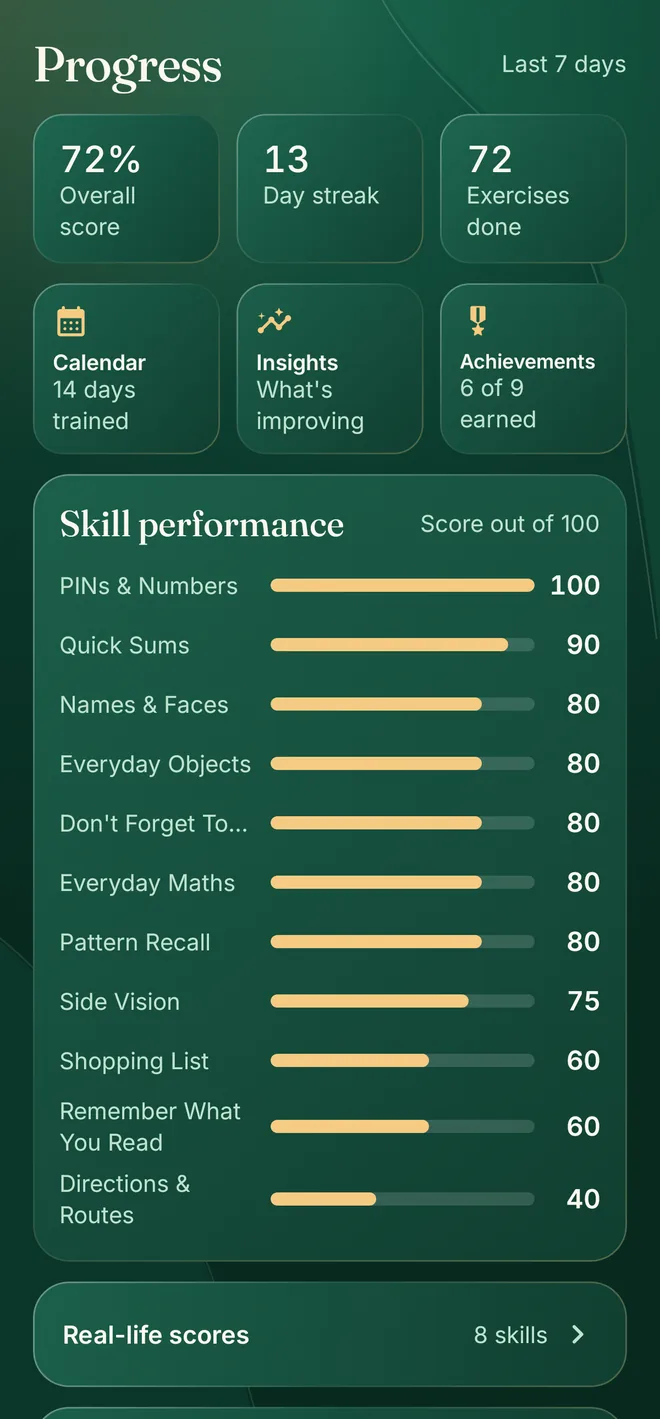
Train the memory you use every day
Keen is an Android app for everyday memory, made for adults 40 and over. Short lessons teach names and faces, PINs and phone numbers, shopping lists and where you put things, with no timers if you like. A monthly check-up uses new material, so you can see whether the skills carry over.