 Keen
Get Keen
Verbal memory test: have you seen this word before?
Words show one at a time. For each word, say if it is new or if you have seen it before in this test. Three wrong answers end the test, and your score is the number of right answers.
Loading the test…
How does the verbal memory test work?
- Read: one word shows at a time. All of them are common things, like a kettle or a bridge.
- Answer: tap New if the word has not come up yet in this test. Tap Seen if it has.
- It gets harder: about half the cards are repeats, and the pile of words you have to keep apart grows with every card.
- Score: each right answer is one point. Three wrong answers end the test.
Psychologists call this a continuous recognition task. Old and new items come in one long stream and you judge each one as it comes (Shepard and Teghtsoonian, 1961). The words are on the page as text, so the test works with a screen reader and a keyboard.
What is a good score on a verbal memory test?
There are no published norms for this online version, so any site that gives you a percentile is guessing. What the research does show is that people are good at knowing a word again. In one classic study, adults went through 540 words once and then picked the old word from pairs of one old and one new. They were right close to nine times in ten (Shepard, 1967).
So do not be surprised if you get far. Most runs end from a slip, not from an empty memory: a fast tap, or a word that only feels familiar. The result screen shows which kind of miss you made.
Compare yourself with yourself, on the same device, at the same time of day. This is a practice task, not a medical test, and it cannot tell you whether anything is wrong with your memory. If memory problems affect your daily life, see a doctor.
Why do you call a new word "seen"?
Because a word can feel familiar for the wrong reason. If you saw "boat" and "ferry", then "canoe" can feel like it was there too. In a well known study, people heard lists of related words, such as bed, rest and awake. Later many of them were sure they had heard "sleep", a word that was never on the list (Roediger and McDermott, 1995).
The other kind of miss is the plain one: a word from far back that left no trace. Both are normal. Knowing which one you make more often tells you what to fix: slow down, or pay more attention the first time.
Is this the test a doctor uses?
No. Clinics use word-list tests where you have to say the words back, which is harder than knowing them again. A common one is the Rey Auditory Verbal Learning Test, or RAVLT. The tester reads a list of 15 words aloud five times. You say back as many as you can after each reading, and again after a delay. A trained person gives it and reads the score against people of your age.
This page tests recognition: is this word old or new? Recall, where nothing is in front of you, is a different job. The free memory test has a short word list you recall, if you want to try that side.
Is memory for words different from memory for pictures?
Yes, pictures are easier. People who looked at thousands of photos, each one once, could still pick most of them out days later (Standing, 1973). In the same study plain words did well too, but below pictures.
That is why turning a word into a picture helps it stick. The photographic memory test checks the picture side, and the digit span test checks numbers held in order.
How do you remember more words?
- See it. Give each word half a second as a picture: a real kettle, your own front door.
- Say it. Say the word quietly once. A word you said is easier to tell apart from one you only read.
- Check before you tap. Ask "when did I see it?" If you can recall a moment, tap Seen. If it only feels familiar, it is often new.
- Keep one pace. Fast taps cause most misses. The test has no clock.
For lists you must recall in order, a first-letter sentence helps: try the mnemonic generator. For names and facts at your job, see memory at work.
Questions
What is a verbal memory test?
A test of memory for words. Here, words show one at a time and you say if each one is new or was shown before. Clinical verbal memory tests ask you to say a word list back from memory.
What is a good score on a verbal memory test?
There are no published norms for this online version. People are good at knowing words again, so long runs are common. One run is noisy, so compare yourself with your own earlier scores.
How does the test end?
Three wrong answers end the test. A wrong answer is calling a new word seen, or calling a seen word new. Your score is the number of right answers.
Is this the same as the RAVLT?
No. In the Rey Auditory Verbal Learning Test a trained tester reads 15 words aloud five times and you say them back. This page checks recognition, which is easier, and it is not a medical test.
Why did a new word feel familiar?
Words that are close in meaning to ones you saw can feel like repeats. Researchers have shown that people often remember a related word that was never shown.
Do I need to sign up?
No. The test runs in your browser with no sign-up, and nothing is saved or sent.
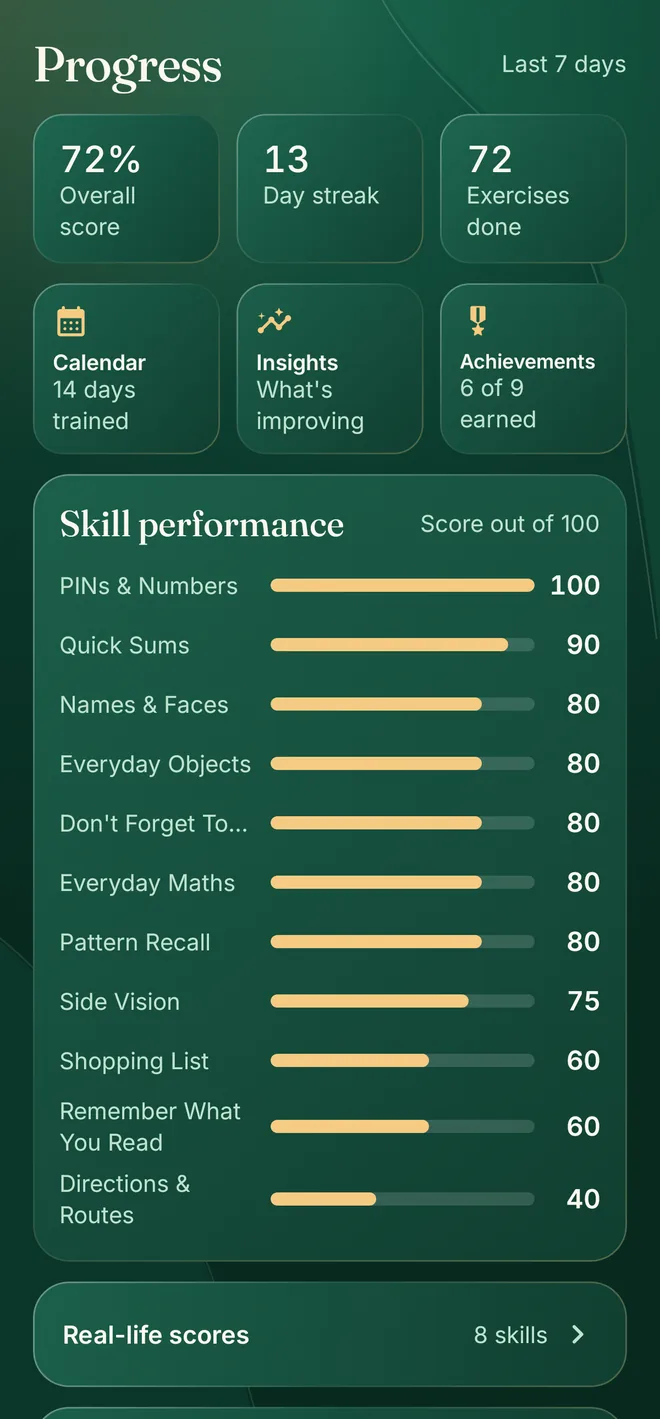
Train the memory you use every day
Keen is an Android app for everyday memory, made for adults 40 and over. Short lessons teach names and faces, PINs and phone numbers, shopping lists and where you put things, with no timers if you like. A monthly check-up uses new material, so you can see whether the skills carry over.