 Keen
Get Keen
Sequence memory test: how long a pattern can you hold?
Squares light up one after another. Tap them back in the same order. Each round repeats the pattern and adds one more square, and your score is the longest pattern you got right.
Loading the test…
How does the sequence memory test work?
- Watch: squares on a 3 by 3 grid light up one at a time. Round 1 is a single square.
- Tap: when the lights stop, tap the same squares in the same order.
- It builds: each round plays the whole pattern again and adds one new square at the end.
- Score: one wrong tap ends the test. Your score is the longest pattern you tapped back in full.
It is the same idea as Simon, the electronic game from 1978, with nine squares and no sound. The test needs you to see the squares, so it does not work with a screen reader.
What is a good score on a sequence memory test?
There are no published norms for this growing version, so any site that gives you a percentile is guessing. The closest lab task is the Corsi block test, where each pattern is new. In a standard version of it, 70 healthy adults held about 6 blocks on average (Kessels and others, 2000).
Here the pattern builds, so you see the start again in every round. That helps, so a score here is not a span and can run higher than 6. Use 6 as a rough yardstick, not a pass mark.
A single round is noisy. One slip of the finger ends it. Compare yourself with yourself, on the same device, at the same time of day. This is a practice task, not a medical test, and it cannot tell you whether anything is wrong with your memory. If memory problems affect your daily life, see a doctor.
Why is a pattern that builds easier than a new one each time?
Because you practise the start again and again. Repeating a sequence makes it stick, even when the repeats are mixed in with other sequences. Psychologists call this the Hebb repetition effect. It was first found with lists of digits, and it also holds for positions on a screen (Couture and Tremblay, 2006). One account links the same effect to how we learn the sound of a new word (Page and Norris, 2009).
So this test measures two things at once: how many new positions you can hold for a moment, and how fast you learn a pattern that keeps coming back. If you want the first one alone, try the digit span test, where every string is new.
Is sequential memory the same thing?
Yes. Sequential memory means remembering things in the right order: the steps of a recipe, the turns on a route, the digits of a phone number. This test checks the visual kind, where the things are places you saw. The spoken kind is what a digit span test checks. People can be stronger at one than the other.
How do you remember a longer sequence?
- Group it. Hold the pattern as groups of three or four squares, not as single squares. Without grouping, people hold only about 4 pieces at a time (Cowan, 2001).
- Trace the path. See the pattern as one line that moves across the grid, like a letter or a zigzag.
- Number the squares. Read the grid like a phone keypad, 1 to 9, and say the numbers quietly. Now you have two memories of the same pattern: where and what.
- Keep a rhythm. Tap at the same pace the lights showed. Rushing the last squares is where most rounds end.
Order matters in daily life too. See where did I put it? for places, and how to remember phone numbers, PINs and dates for digits. The photographic memory test checks what you saw and where, and the dual n-back test is a harder task that mixes positions and letters.
Questions
What is a sequence memory test?
A test of how long a pattern you can hold in order. Squares light up one after another, you tap them back in the same order, and the pattern gets one square longer each round.
What is a good score on a sequence memory test?
There are no published norms for the growing version. As a rough yardstick, adults hold about 6 positions when every pattern is new, and a pattern that builds can go further. One round is noisy, so try a few times.
Is this the same as the Corsi block test?
No, but it is close. In the Corsi block test every pattern is new and you get two tries at each length. Here the same pattern comes back and grows by one, which makes it easier to go far.
What is sequential memory?
Remembering things in the right order, like the steps of a recipe or the digits of a phone number. This test checks the visual kind, where the things are places on a grid.
Can you get better at a sequence memory test?
Yes, at this task. Grouping the squares in threes and tracing the pattern as a path both help. Getting better here does not mean your whole memory got bigger.
Do I need to sign up?
No. The test runs in your browser with no sign-up, and nothing is saved or sent.
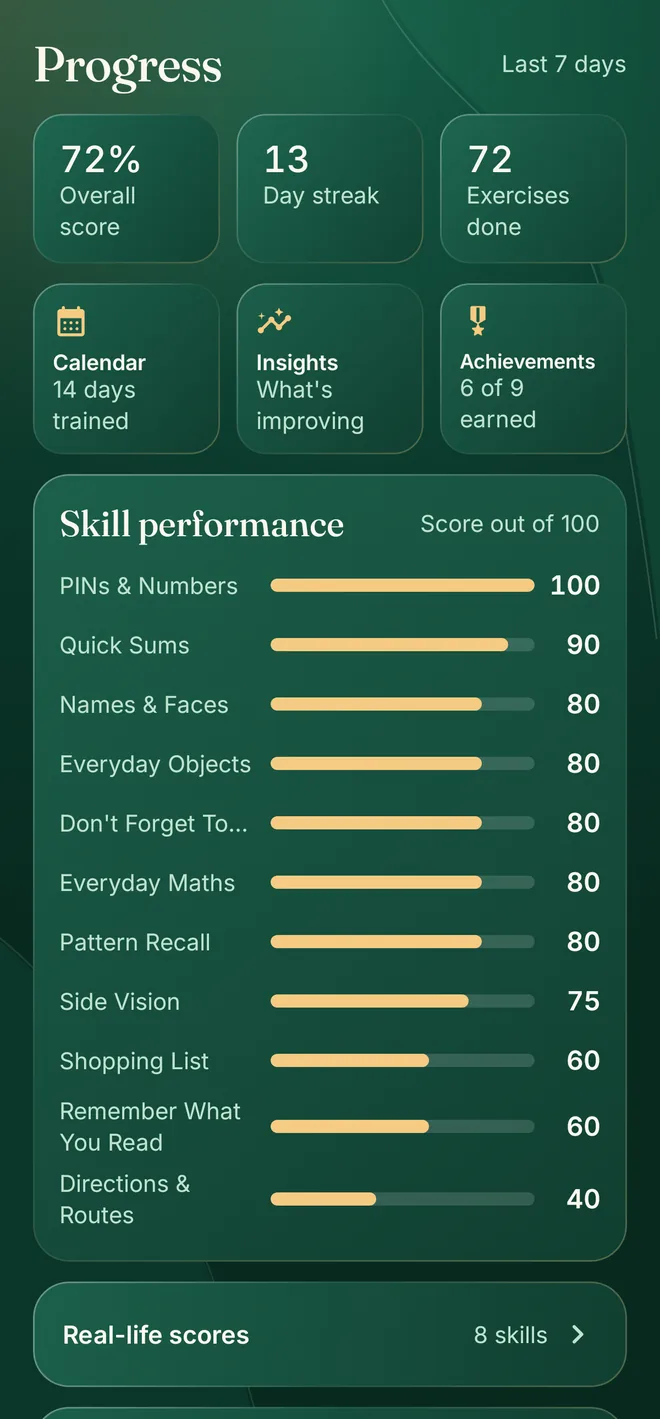
Train the memory you use every day
Keen is an Android app for everyday memory, made for adults 40 and over. Short lessons teach names and faces, PINs and phone numbers, shopping lists and where you put things, with no timers if you like. A monthly check-up uses new material, so you can see whether the skills carry over.