 Keen
Get Keen
Stroop test: tap the ink colour, not the word
A colour word shows in coloured ink. Tap the colour of the ink, not the word. After 24 cards you see how much slower you were when the word and the ink did not match. That gap is your Stroop effect.
Loading the test…
English Deutsch Español Français Italiano 한국어 Nederlands Polski Português (Brasil) Svenska ไทย Türkçe
How does the Stroop test work?
- Look: a colour word shows, such as RED, printed in red, blue, green or purple ink.
- Tap: tap the button for the ink colour. Do not tap the word you read.
- Two kinds of card: on half the cards the word and the ink match. On the other half they differ.
- Score: you get your mean time for each kind of card, in milliseconds, and the number of wrong answers. Wrong answers are left out of the times.
The test needs colour vision. If red and green look alike to you, the times will not mean much. On a keyboard, press R, B, G or P.
What is the Stroop effect?
The Stroop effect is the slowdown you get when a word says one colour and its ink is another. You know the task is to name the ink, but you read the word anyway, and the two answers get in each other's way.
John Ridley Stroop showed it in 1935. In his second experiment, people named the ink colours of 100 colour words that did not match, and it took them 74% longer than naming the colours of plain squares (Stroop, 1935). It has been tested again and again since then. One review covers more than fifty years of studies on it (MacLeod, 1991).
What is a good score on the Stroop test?
There is no pass mark. Almost everyone is slower on the cards that do not match, and that is the normal result. The number to look at is the gap between your two times, not the times alone.
There are no published norms for a tap version on a phone. Your times depend on your screen, your browser and your thumbs, so do not compare them with numbers from another site or from a paper. Compare yourself with yourself, on the same device.
A small gap with few mistakes means you kept the word out of the way well this round. A big gap, or many mistakes, means the word got in. One round of 24 cards is noisy, so try a few rounds. This is a practice task, not a medical test, and it cannot tell you whether anything is wrong with your attention or memory. If you are worried, see a doctor.
Why is it so hard to ignore the word?
Because for a practised reader, reading is fast and starts by itself. Naming a colour is slower and takes a bit of effort. So the word is ready before the colour is, and you have to hold it back. Those two ideas, speed and habit, are the main accounts in the research (MacLeod, 1991).
That is why psychologists use the task to look at attention and self-control: it shows how well you can stop a strong habit and give the answer the task asks for. It is not a memory test.
Is an online Stroop test the same as the clinical one?
No. The clinical version is the Stroop Color and Word Test. You read words and name colours aloud from printed sheets, and a trained person counts how many you get through in a set time, or how long a sheet takes. Even there, the way it is scored is not the same in every study (Scarpina and Tagini, 2017).
This page times single taps on a screen. It shows the same effect, but the numbers are not on the same scale as a clinic report.
Can you make your Stroop effect smaller?
- Practise. In Stroop's third experiment, eight days of practice made the gap smaller. That is practice at this task, not a wider gain.
- Look at the edge of the word. If you fix your eyes on one letter, you take in the colour and read less of the word.
- Do not rush. Wrong answers come from speed. A steady pace gives a cleaner result.
- Same time, same device. Tired or on a new screen, your times shift for reasons that have nothing to do with attention.
For memory, try the digit span test or the free memory test. For a harder task that mixes attention and memory, try the dual n-back test. For thinking habits, see critical thinking games for adults.
Questions
What is the Stroop test?
A test where colour words are printed in coloured ink and you name the ink, not the word. When the word and the ink differ, people slow down. That slowdown is the Stroop effect.
What is a good score on the Stroop test?
There is no pass mark. Almost everyone is slower when the word and the ink differ. Look at the gap between your two times and compare it with your own earlier rounds on the same device.
What does the Stroop test measure?
How well you can hold back a strong habit, reading, and give the answer the task asks for, the ink colour. Psychologists use it to study attention and self-control.
Who found the Stroop effect?
John Ridley Stroop published it in 1935. In his study, naming the ink of colour words that did not match took 74% longer than naming the colours of plain squares.
Is this a medical test?
No. It is a practice task. The clinical Stroop Color and Word Test is given on printed sheets by a trained person, and its scores are not on the same scale as this page.
Do I need to sign up?
No. The test runs in your browser with no sign-up, and nothing is saved or sent.
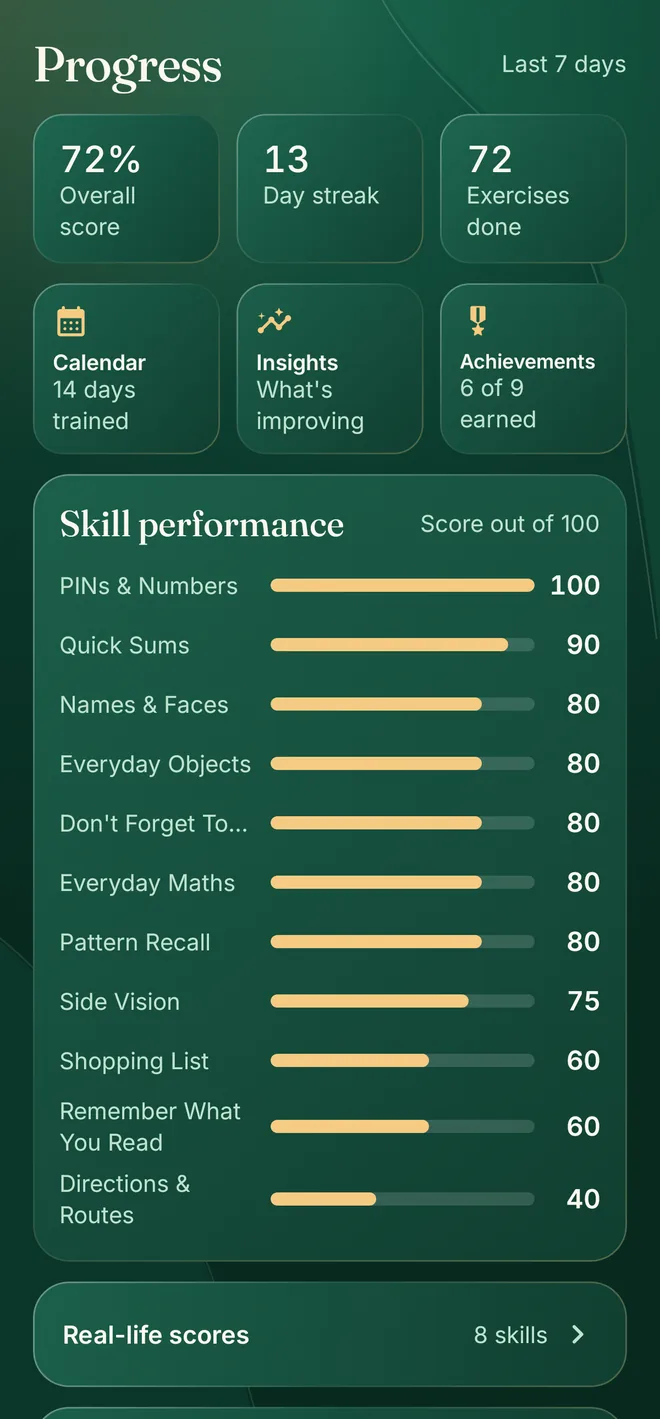
Train the memory you use every day
Keen is an Android app for everyday memory, made for adults 40 and over. Short lessons teach names and faces, PINs and phone numbers, shopping lists and where you put things, with no timers if you like. A monthly check-up uses new material, so you can see whether the skills carry over.