 Keen
Get Keen
Photographic memory test: free online picture recall
Study a picture of objects on a grid for a few seconds. Then say what was there and where it was. Six questions, three levels.
Loading the test…
How does the photographic memory test work?
- Study: a 4 by 4 grid shows 6, 9 or 12 everyday objects for 20, 15 or 10 seconds. Press I am ready if you want to stop early.
- Answer: six questions in three kinds. Which object was in the picture, what was in a marked square, and where a given object was.
- Score: you see how many you got right, how many places you remembered, and the picture again so you can check.
What does your score mean?
On medium, 5 or 6 out of 6 is a good result. Most people do better on what than on where: places fade faster than objects. A single round is noisy, and a tired evening or a busy room costs points. This is a practice task, not a medical test, and it cannot tell you whether anything is wrong with your memory. If memory problems affect your daily life, see a doctor.
Is photographic memory real?
Not the camera kind. What research has found is eidetic imagery: some children can still see a picture for a short time after it is taken away. In one early study, about 1 in 12 school children showed it (Haber and Haber, 1964), and even their images were not perfect and faded within minutes. A review of twenty years of this work found it is rare, mostly in children, and not the same as a better memory (Haber, 1979).
The best known adult case was a woman who seemed to merge two random-dot pictures from memory (Stromeyer and Psotka, 1970). She was never tested again, and nobody else has done it since. People who win memory contests use methods, like linking each item to a place on a mental walk, not a camera in their head.
How can you remember a picture better?
- Name it. Say each object to yourself. Words stick better than a blur of shapes.
- Link it to its place. "Key in the top corner, like a key on a hook by the door." A small story ties the what to the where.
- Go in order. Scan row by row, the same way each time, so you can walk back through it later.
These are the same tricks that help with real life: remembering where you put things, names and faces, or the words in our free memory test. If you liked this, try the harder dual n-back test for working memory.
Questions
Is photographic memory real?
Not in the way films show it. A small share of children can hold a picture in view for a short time after it is gone, called eidetic imagery, but it fades and is not perfect. In adults no case of a true camera-like memory has held up under testing.
What is the difference between eidetic and photographic memory?
Eidetic memory means still seeing an image for a few seconds after it is gone, mostly found in children. Photographic memory usually means recalling any page or scene in perfect detail later, which research has not found.
What is a good score on this test?
Getting 5 or 6 of 6 right on medium is a good result. Most people remember what they saw better than where it was, so the places score is often lower.
Can you train your visual memory?
Yes, for the things you practise. Naming each object and linking it to its place while you look works better than staring. It will not give you a camera in your head.
Do I need to sign up?
No. The test runs in your browser with no sign-up, and nothing is saved or sent.
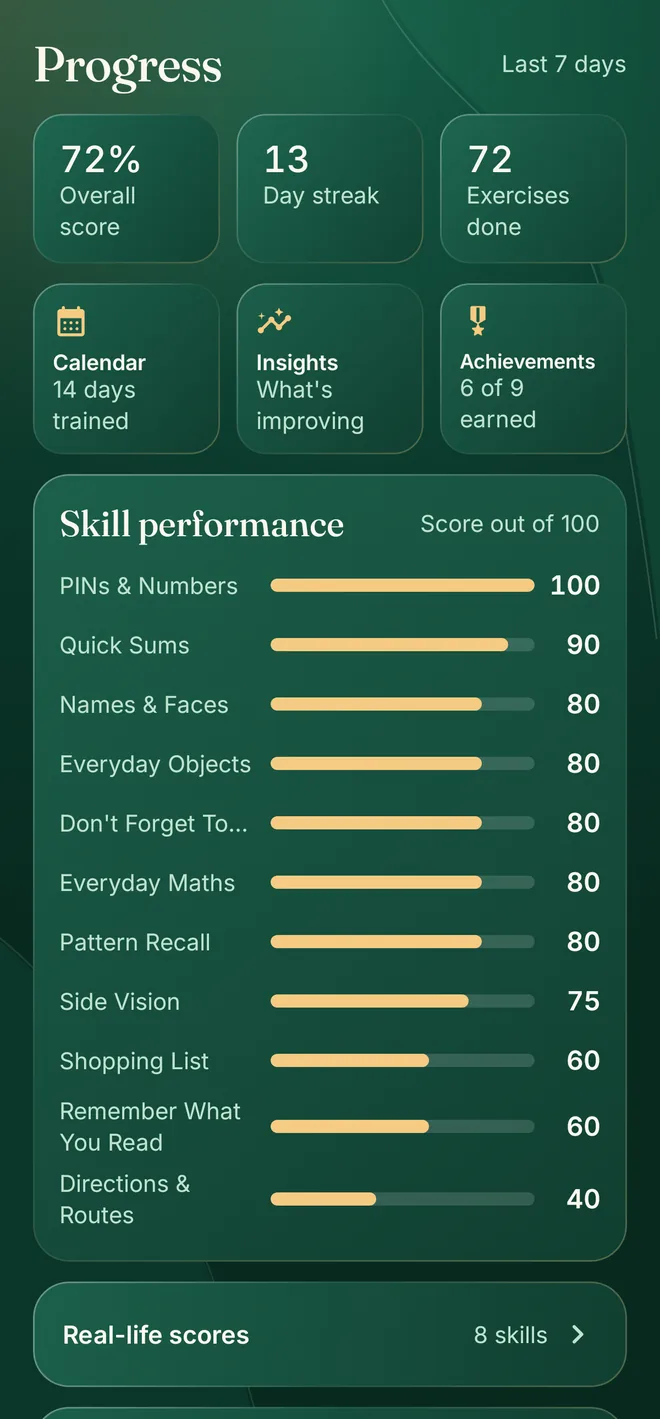
Train the memory you use every day
Keen is an Android app for everyday memory, made for adults 40 and over. Short lessons teach names and faces, PINs and phone numbers, shopping lists and where you put things, with no timers if you like. A monthly check-up uses new material, so you can see whether the skills carry over.