 Keen
Get Keen
Digit span test: free online number memory test
Digits show one at a time. Type them back in the same order, or backward. Each time you are right the next one is a digit longer, and your span is the longest one you got.
Loading the test…
How does the digit span test work?
- Watch: digits show one at a time, one per second. Forward starts at 3 digits, backward at 2.
- Type: forward means the same order. Backward means last digit first, so 4 7 1 becomes 1 7 4.
- Two tries per length: get one right and the next is a digit longer. Miss both and the test ends.
- Score: your span is the longest length you got right.
In the classic test a person reads the digits out loud. Here you see them on the screen, so your result can be a little different from a spoken test.
What is a normal digit span?
Most adults can hold about 7 digits forward, give or take 2. That figure comes from George Miller's well known paper on "the magical number seven" (Miller, 1956). The test itself is older: Joseph Jacobs used it with London school pupils in 1887 and saw that older pupils could hold longer strings (Jacobs, 1887).
Backward, most people score a digit or two lower, so around 5 is common. Scores also move with age and schooling: in a norm study of 362 healthy adults aged 20 to 90, spans went down slowly with age and up with years of education (Monaco and others, 2013). So compare yourself with yourself, not with one number.
A single round is noisy. A tired evening or a busy room costs a digit. This is a practice task, not a medical test, and it cannot tell you whether anything is wrong with your memory. If memory problems affect your daily life, see a doctor.
Why is backward harder than forward?
Forward, you only have to hold the digits. Backward, you hold them and turn them around at the same time. That is why researchers treat forward span as mostly storage, and backward span as storage plus control, which is closer to what people mean by working memory (Monaco and others, 2013). If you want a harder working memory task after this, try the dual n-back test. For places in place of digits, try the sequence memory test or the Corsi block test.
Can you improve your digit span?
Yes, for digits. In a famous study, a student practised this exact task for about an hour a day, a few days a week, for more than a year and a half. After more than 230 hours his span went from 7 digits to 79 (Ericsson, Chase and Faloon, 1980). He was a runner, and he turned groups of digits into race times: 3492 became "3 minutes 49.2 seconds, near the world record for the mile".
Two honest notes. His span for letters stayed ordinary, so he had learned a method for digits, not a bigger memory. And the raw limit may be smaller than 7: when people cannot group or repeat the items, they hold about 4 pieces (Cowan, 2001). A span of 7 is already digits packed into a few pieces.
How do you remember more digits?
- Group them. Read 4 7 1 9 3 8 as 471 and 938. Two pieces are easier than six digits.
- Say them in rhythm. A short pause between groups, the same way every time.
- Give a group a meaning. A year, an age, a price, a bus number. One group with a meaning often pulls the rest out.
The same steps work for real numbers. See how to remember phone numbers, PINs and dates. For a list of words, not digits, the mnemonic generator turns first letters into a sentence. Our free memory test checks a shopping list and a number, and the photographic memory test checks what you saw and where.
Questions
What is a normal digit span?
Most adults can repeat about 7 digits forward, give or take 2. Backward, most people score a digit or two lower, so around 5 is common.
What is a good score on a digit span test?
7 or more forward, or 5 or more backward, is a solid result. 9 or more forward is well above the usual range. One round is noisy, so try a few times before you read much into it.
How is the digit span test scored?
Your span is the longest string of digits you typed back correctly. You get two tries at each length. One right answer moves you up a digit, and two misses at the same length end the test.
What does backward digit span measure?
Working memory: holding numbers in mind and reordering them at the same time. Forward span is mostly about holding them.
Can you improve your digit span?
Yes, for digits. Grouping digits into chunks and giving the chunks a meaning can raise a span a lot with practice. The gain is for numbers; it does not make your whole memory bigger.
Do I need to sign up?
No. The test runs in your browser with no sign-up, and nothing is saved or sent.
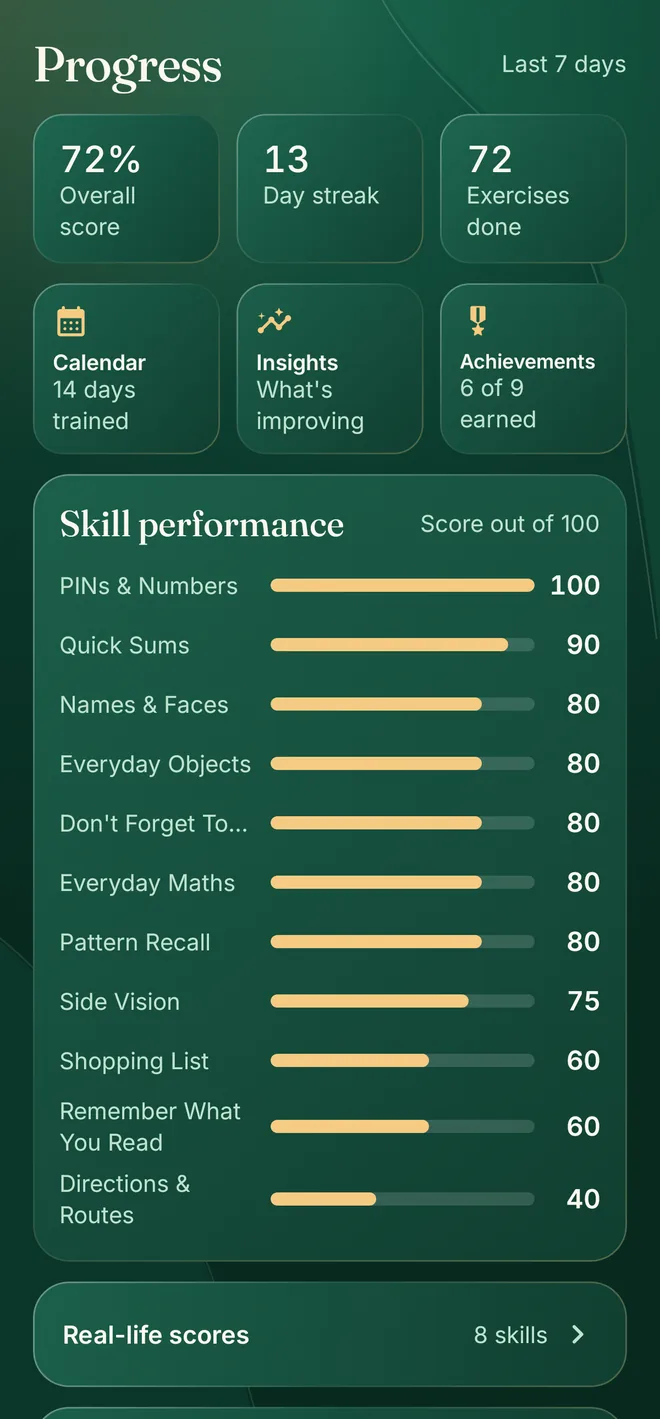
Train the memory you use every day
Keen is an Android app for everyday memory, made for adults 40 and over. Short lessons teach names and faces, PINs and phone numbers, shopping lists and where you put things, with no timers if you like. A monthly check-up uses new material, so you can see whether the skills carry over.