 Keen
Get Keen
Working memory exercises for adults over 50
Working memory is what you hold in mind while you use it, like a phone number you are about to dial. Practice makes you better at the task you practise, with small gains that do not reliably spread. Start with digit span, try the others below, and keep it to five minutes.
These are the working memory tasks researchers use, free in your browser with no sign-up and nothing sent or saved. They sit next to a printable sheet for days you want paper. After 50, slower recall is common and usually ordinary, and short, regular practice at your own pace is a fair way to stay in touch with your own memory.
What is working memory, and why does it feel harder after 50?
Working memory is your mental scratchpad. You use it to carry a number from the shop screen to your card reader, follow a recipe step, or keep a name in mind until the person turns round. It holds a few items for a few seconds and is easily knocked off by interruptions, tiredness and stress.
On average, working memory scores drift down with age, and the change is gradual. Many people notice it as losing a thought mid-sentence or walking into a room and forgetting why. That is common, and it is not a diagnosis. If memory problems affect your daily life, the NHS advises seeing a GP (NHS: memory loss).
Which free working memory exercises can you try now?
Try them in this order, easiest first. Each page explains the rules and gives you a score you can ignore.
- Digit span. Numbers show one at a time, then you type them back, forward or backward. The easiest place to start and a clear way to see your own span.
- Sequence memory. Squares light up one after another and the pattern grows by one each round. Tap it back in order.
- Corsi block tapping. Nine blocks light up in order. Tap them back in the same order, or backward. A spatial task, so it practises a different kind of holding than numbers.
- Dual n-back. Squares light up and a voice says letters. Spot when either matches the one from 1 to 4 turns ago. The hardest task here, so start at 1-back or single mode.
- Verbal memory. Words show one at a time. Say if each one is new or seen before. This is recognition memory rather than working memory, but it is a calm warm-up.
- Printable memory exercises. Five everyday exercises, a large-print PDF and a 7-day tick sheet. Paper, a pen and a timer; no screen needed.
Not sure where to start? Take the free 3-minute memory test, which looks at everyday memory, then pick one task above.
How should you practise?
- Five to ten minutes, a few days a week. A short routine you keep beats a long one you drop.
- Stay one level below your limit at first. Move up when a level feels comfortable, not when it is only possible.
- Use a quiet moment. Phone away, same time each day.
- Practise real tasks too. Hold a phone number in chunks, link a shopping list into a short story, say a new name back. See how to remember names and how to remember dates and numbers.
Do working memory exercises actually work?
Honest answer: they work for the task you practise. You will get better at digit span, n-back or block tapping. A large review of working memory training found short-term gains on similar tasks, which is called near transfer, and no reliable gains on other skills (Melby-Lervåg and Hulme, 2013). A meta-analysis of n-back training reached a similar view: small gains on untrained working memory tasks and little evidence for wider effects (Soveri and others, 2017).
- No IQ claim. Nothing here is shown to raise intelligence or reasoning.
- No dementia claim. None of these tools prevents, treats or tests for dementia, and they are not medical tests.
- Use them as practice. They are useful for getting a feel for how your own memory behaves, and for a calm daily habit. For everyday gains, practise the everyday task directly.
Studies differ in design and size, so treat all of this as a fair summary, not the last word.
How does Keen fit in?
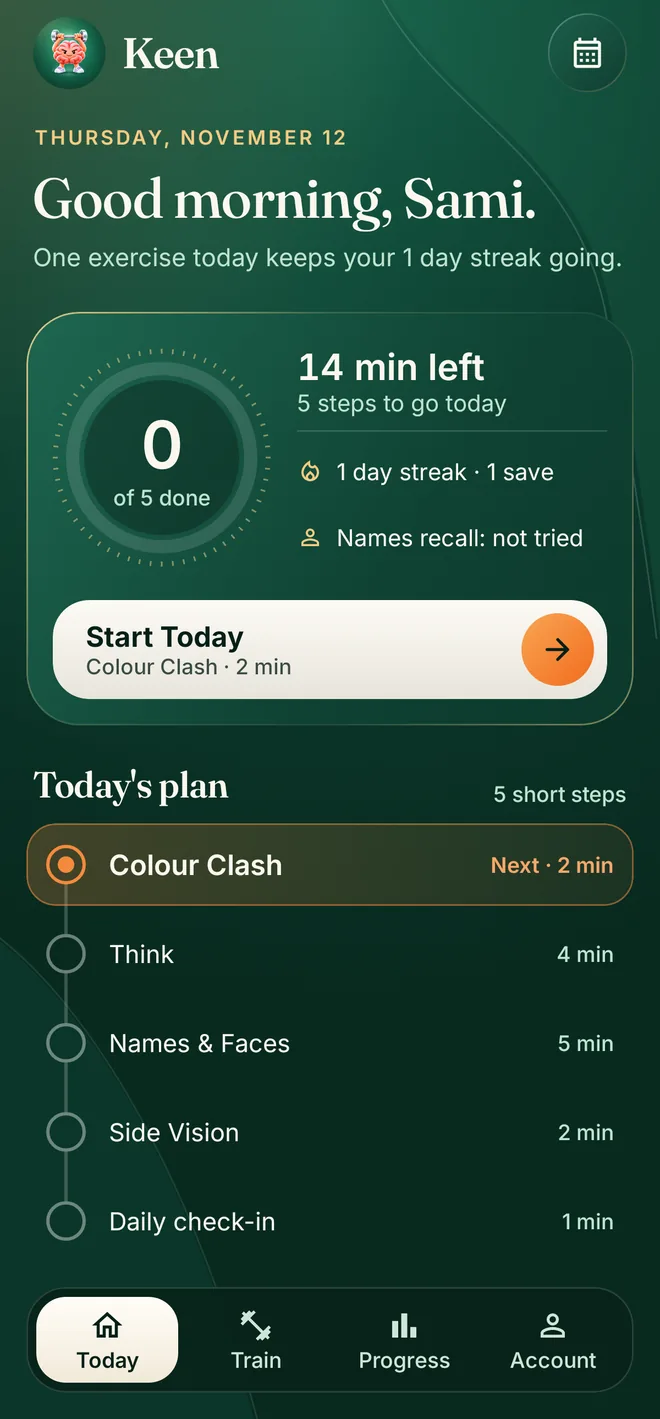
Disclosure: we make Keen. It is an Android app that turns this kind of practice into a daily plan of short games and real-life lessons, for example names and faces, shopping lists and PINs. The free plan is one game a day and everything else needs Premium. You do not need it for anything on this page.
Questions
What are the best working memory exercises for adults over 50?
Tasks that make you hold and use information for a few seconds: digit span, Corsi blocks, n-back and sequence recall. Start with the easy ones, such as digit span forward, and move up only when a level feels comfortable.
Can working memory be trained?
You get better at the tasks you practise. Large reviews find that this near transfer is real but small, and that it does not reliably spread to other skills. Practise to make the task familiar, not to expect a wider change.
How often should I do these exercises?
Five to ten minutes, a few days a week, is a sensible start. A short routine you keep doing beats a long one you skip.
Do working memory exercises prevent dementia or raise IQ?
No. There is no good evidence that these exercises prevent dementia or raise IQ, and nothing on this page claims it. They are practice for specific tasks. If memory problems affect your daily life, see a GP or doctor.
Do I need to sign up or install anything?
No. Every tool here runs in your browser, is free, and sends nothing. The printable sheet is a PDF.
Related
- Printable memory exercises (5 minutes, 7-day tick sheet)
- Free memory test (3 minutes, not a medical test)
- Relaxed brain games for 50 to 60 year olds
- Brain training apps for adults, compared
Practise it ten minutes a day
Keen is an Android app with calm daily practice for adults 40 and over: one game, one real-life lesson, a short Side Vision exercise and a check-in. No ads, and a relaxed mode with no timers.